
Ketamine vs. Auvelity for Depression: The 2026 Battle of Rapid-Acting NMDA Treatments
Executive Summary: As of April 2026, the landscape for Treatment-Resistant Depression (TRD) has shifted from serotonin-based SSRIs to glutamate-based NMDA modulation. While Auvelity offers a convenient daily oral option, Ketamine therapy remains the clinical “Gold Standard” for potency and rapid synaptogenesis. This guide breaks down the data to help you decide which path to recovery is right for you.
If you are exploring the best treatment for treatment-resistant depression, you have likely encountered two names: Ketamine and Auvelity. In 2026, these are the leading rapid-acting antidepressants available to patients who have failed traditional medications. Both represent a departure from the “Monoamine Hypothesis” of depression, focusing instead on the brain’s ability to repair itself through glutamate-based depression treatment.
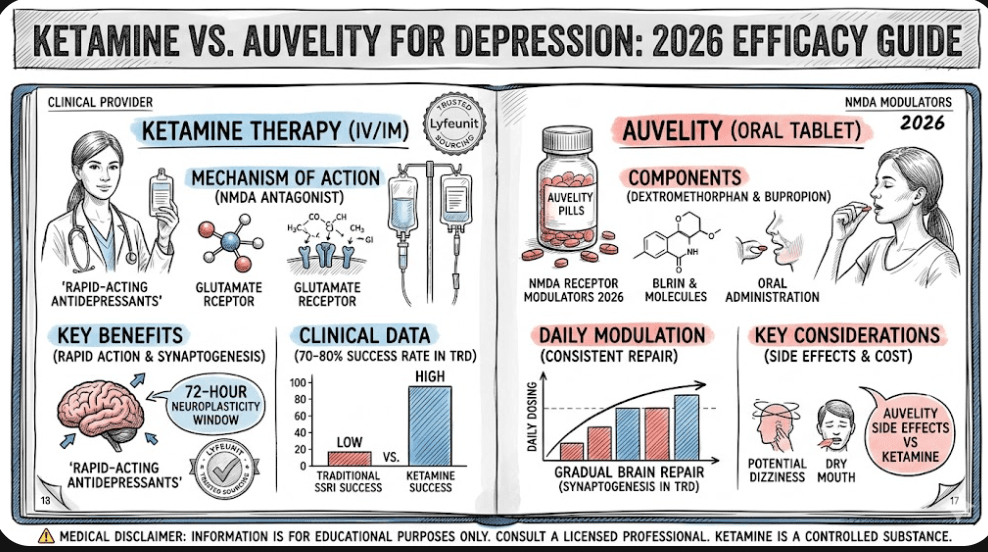
But which is more effective? Is the convenience of a daily pill like Auvelity worth the trade-off in potency compared to a clinical ketamine infusion? To answer this, we must look at how these NMDA receptor modulators 2026 interact with your brain’s architecture during the critical 72-hour neuroplasticity window.
The Mechanism: How Both Modalities Target Glutamate
Traditional antidepressants (SSRIs) work by increasing serotonin in the synaptic cleft—a process that can take 6-12 weeks to manifest as mood improvement. Conversely, both Ketamine and Auvelity are NMDA receptor antagonists. By blocking these receptors, they trigger a “glutamate burst” that stimulates the production of Brain-Derived Neurotrophic Factor (BDNF).
This process leads to synaptogenesis in TRD—the regrowth of neural connections that have withered due to chronic stress. However, the intensity of this repair differs significantly between the two. While Auvelity provides a low-level, consistent modulation, Ketamine provides a profound “reset” that many patients describe as a mental overhaul. For those seeking the highest purity for clinical results, sourcing pharmaceutical grade ketamine powder is essential for ensuring these biological pathways are successfully activated.
Efficacy Comparison: Ketamine vs. Auvelity for Depression
When analyzing Ketamine vs Auvelity for depression, the “Response Rate” is the most critical metric. Clinical data in 2026 suggests that Ketamine infusions maintain a 70% to 80% response rate in TRD patients, while Auvelity (dextromethorphan-bupropion) typically shows statistical improvement within 1-2 weeks but has weaker direct blockade than ketamine.
2026 Comparative Data Table
| Feature | Ketamine (IV/IM/Spravato) | Auvelity (Oral Tablet) |
|---|---|---|
| Main Components | Pure Ketamine HCl / Esketamine | Dextromethorphan & Bupropion |
| Onset of Action | 2 to 24 Hours | 1 to 2 Weeks |
| Administration | Clinic-Based Infusion/Spray | Daily At-Home Pill Source: GoodRx: Fast-Acting Antidepressants Guide |
| Dissociative Effects | Moderate to High (Therapeutic) | Minimal to None Source: Drugs.com: Auvelity vs. Spravato Comparison |
| Success Rate (TRD) | 70% – 80% | ~45% |
Logistics and Cost: The 2026 Reality – Best treatment for treatment-resistant depression
One of the biggest factors in the Ketamine vs Auvelity debate is the cost. Auvelity is often covered by traditional pharmacy benefits, but its sticker price remains high. Conversely, while the ketamine infusion cost 2026 averages $400-$800 per session, the results are often sustained for weeks after an induction cycle. This comparison of oral vs IV ketamine for depression shows that while oral options like Auvelity are convenient, IV remains the leader in bioavailability.
For those managing their own treatment logistics, understanding shipping and handling for ketamine supplies is vital for maintaining treatment consistency. Reliability in the supply chain is what separates a successful clinic from a struggling one.
Side Effects: Dissociation vs. Daily Management
When comparing Auvelity side effects vs ketamine, we look at intensity versus duration.
- Ketamine: Side effects are acute but transient. During the session, you may experience dissociation or mild nausea. However, these resolve within 2 hours. This is why learning how to prepare for ketamine assisted therapy is so crucial.
- Auvelity: Common side effects include dizziness (12.7%), nausea (11.9%), and headache (8.8%). Because it is a daily pill, these can be persistent.
The Integration Factor: Why Ketamine Offers More
Auvelity is a pill you take and forget. Ketamine is an experience you integrate. To truly move from “depressed” to “thriving,” you must focus on ketamine integration therapy. The dissociative state allows for a perspective shift that daily oral medications simply cannot provide. This “psychological breakthrough” is a cornerstone of ketamine for depression success.
Which Treatment is Right for You?
In 2026, many clinicians are moving toward a hybrid model. They use Ketamine infusions for the initial synaptogenesis in TRD reversal and then consider Auvelity for maintenance. If you are a medical provider or researcher looking to offer the highest tier of relief, you can Shop ketamine Wares directly from our Catalog.
FAQ: Ketamine vs Auvelity
A: No. Ketamine works in hours. Auvelity typically takes 1 to 2 weeks to show significant improvement.
A: For Auvelity, check your reaction to dizziness. For Ketamine, you MUST arrange transportation home.
⚠️ Medical Disclaimer
This comparison of Ketamine vs Auvelity for depression is for educational purposes only. Lyfeunit provides pharmaceutical grade compounds for clinical use and does not provide medical treatment. Always consult a licensed physician.