Summary: Legacy banking networks and integrated credit card processors present critical vulnerabilities to personal patient data, exposing therapeutic histories to predatory insurance algorithms and centralized security breaches. Utilizing decentralized cryptocurrency medical privacy networks eliminates intermediate merchant logging entirely. By routing acquisitions through peer-to-peer cryptographic ledger systems, healthcare consumers deploy zero-knowledge validation frameworks that permanently decouple a user’s physical medical identity from their financial footprint, ensuring absolute sovereignty over sensitive research timelines.
The Crisis of Centralized Healthcare Financial Logging
In the modern digital landscape, the preservation of personal medical privacy has escaped the boundaries of simple compliance and evolved into a fundamental necessity for individual sovereignty. Every time a consumer utilizes a traditional fiat payment rail—such as a Visa corporate card, a Mastercard credit line, or a centralized bank wire—to secure specialized therapeutic materials, an immutable digital audit trail is generated. This financial footprint travels far beyond the merchant of record.
Traditional payment processors routinely aggregate consumer purchasing metrics, cross-referencing transactional data with Merchant Category Codes (MCC). This accumulated data is frequently bought, sold, or leaked to third-party clearinghouses, corporate data brokers, and underwriting algorithms managed by health insurance conglomerates. For individuals utilizing advanced clinical modalities or exploring alternative neurological recovery protocols, this systemic exposure presents a profound risk. A single flagged line item on a standard banking statement can lead to arbitrary insurance premium hikes, unexpected policy denials, or compromised corporate vetting records. To resolve this structural vulnerability, high-end sourcing networks have transitioned away from fragile banking intermediaries to implement strict, enterprise-grade secure cryptocurrency medical privacy frameworks.
Cryptographic Discretion: Decoupling Identity from Financial Logs
The core mechanism driving secure alternative distribution networks is the absolute separation of financial metadata from personal identity records. Centralized payment gateways demand comprehensive Know Your Customer (KYC) documentation, forcing buyers to upload government-issued IDs, physical utility bills, and verifiable bank credentials just to initiate a basic checkout flow. This connects your private health choices directly to a traceable, permanent government database.secure cryptocurrency medical privacy
When operations are migrated to a native decentralized blockchain patient data matrix, this connection is broken. Cryptographic protocols operate via public-key cryptography, where transactions are authenticated using a pairing of alphanumeric public strings and private access keys. The ledger records that an exact volume of digital asset value moved from Address A to Address B at a specific timestamp, but it contains zero rows for your name, birthdate, billing coordinates, or medical diagnostic history. This ensures that your private therapeutic strategy remains entirely your own property, inaccessible to corporate scrapers or unauthorized centralized audits.
Advanced Ledger Privacy: Monero and Bitcoin Transaction Dynamics
While all digital assets share a basic foundation of decentralization, their underlying architectural designs offer varying degrees of network obfuscation. Understanding the specific differences between public ledgers and specialized privacy protocols is crucial for maintaining an unbreachable operational footprint during clinical sourcing sequences.
Bitcoin operates on a transparent, pseudonymous public blockchain. While a wallet address is not directly stamped with a user’s name, every transaction input, output, and historical balance is viewable to anyone using a public blockchain explorer. Over time, sophisticated blockchain analytics companies utilize advanced clustering heuristics and data matching to deanonymize public keys. To counter this, specialized networks require anonymous healthcare transaction protocols. Protocols like Monero utilize three distinct cryptographic masking technologies: Ring Signatures (which mix the sender’s transaction with multiple decoy inputs), Stealth Addresses (which generate a unique, one-time destination address for every single payout), and RingCT (Ring Confidential Transactions, which blind the exact volume of funds being sent). This ensures that every layer of the transaction remains completely invisible to outside observers, providing the gold standard for clinical procurement security.
Comparative Architecture: Centralized Fiat vs Decentralized Crypto
To visualize how modern cryptographic frameworks outpace legacy banking loops in safeguarding user sovereignty, review this structural breakdown of data exposure across the primary payment options available in the global supply ecosystem.
| Security Matrix Component | Legacy Bank Rails (Visa / Wire) | Public Blockchains (Bitcoin / ERC20) | Privacy Protocols (Monero XMR) |
|---|---|---|---|
| Identity Requirements | Mandatory KYC, Passports, Full Billing Info | None (Pseudonymous wallet access strings) | Absolute Zero (Total cryptographic anonymity) |
| Transaction Visibility | Fully visible to banks, brokers, and insurance AI | Publicly trackable via open-source ledger nodes | Completely blinded (Inputs, outputs, and sums masked) |
| Data Interception Risk | High (Subject to data breaches and merchant leaks) | Low (Requires advanced heuristic pattern linking) | None (Protected by mathematical Ring Signatures) |
| Third-Party Settlement Logs | Permanent archives retained by clearing houses | Decentralized global node validation map | Decentralized validation with zero history logging |
| Fulfillment Interactivity | Forced attachment to personal credit history profiles | Independent cryptographic validation layer | Isolated, secure peer-to-peer asset clearance |
The Role of Zero-Knowledge Validation Proofs
At the cutting edge of digital data protection lies a mathematical framework known as zero knowledge validation proofs (ZKP). This mathematical breakthrough allows one party (the buyer) to prove to another party (the distribution network) that a specific statement is completely true without revealing any auxiliary information beyond the statement’s validity itself.
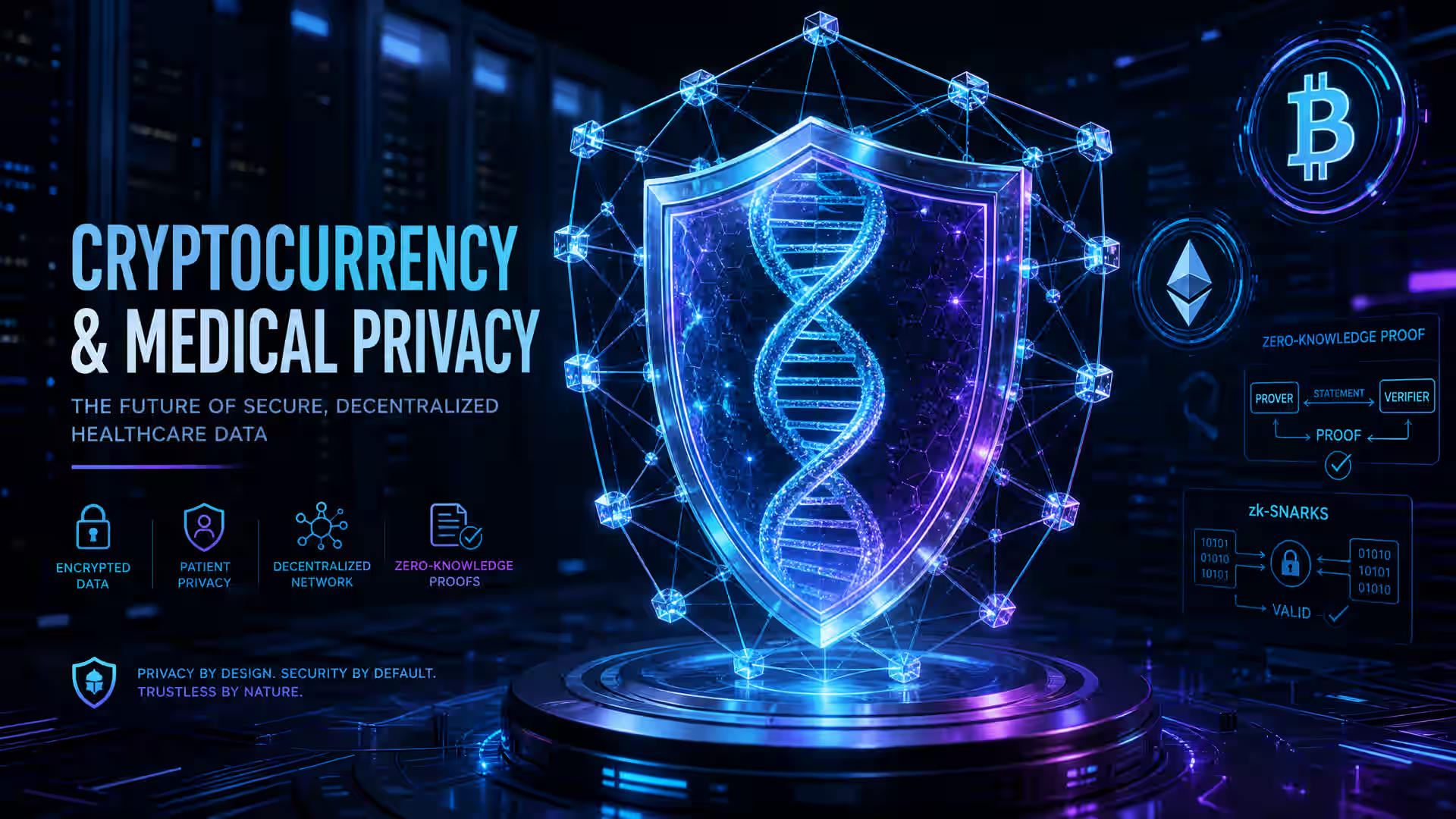
In standard e-commerce setups, a vendor must check your specific account balance or verify your credit card funds by running your complete data profile through a series of third-party screening centers. This exposes your financial background and identity to multiple vectors of vulnerability. In contrast, cryptographic nodes utilizing zero-knowledge parameters can confirm that a transaction is fully funded, authentic, and authorized without needing to know who you are, where you live, or how many total assets are held in your private wallet repository. This allows for seamless, instantaneous processing of high-stakes logistical allocations while maintaining a completely impenetrable firewall around your identity records.
Securing the Material Pipeline: End-to-End Cryptographic Privacy
True data protection cannot stop at the digital checkout interface; it must seamlessly integrate with physical logistics workflows to guarantee comprehensive protection. Once an entry is verified on the blockchain, the fulfillment engine must transition your shipping information into an isolated, short-term processing matrix designed to eliminate data permanence.
To maintain secure medical supply lines, raw shipping metadata is encrypted immediately upon submission using military-grade AES-256 protocols. Your tracking destination is accessible only to the specific shipping node preparing the physical container. Once your parcel clears regional customs nodes and achieves successful final-mile delivery to your designated drop-off coordinates, your temporary order records are permanently expunged from our operational routing networks. This absolute data-destruction protocol ensures that even in the impossible event of an exterior system audit, there is no historical database left behind for anyone to scrape, exploit, or decode.
Ensuring Technical Safety for Crypto Transactions
To safely navigate alternative payment networks without introducing accidental data leaks, healthcare consumers and clinical researchers must adhere to strict operational hygiene protocols. The entire purpose of blockchain security is defeated if a user routes their payment directly from a centralized, KYC-verified exchange account link, as the exchange retains a permanent log of the external destination address.
To achieve flawless transactional isolation, users must utilize an independent, non-custodial software or hardware wallet to manage their assets. This gives you exclusive control over your private seed phrase, preventing third-party platforms from freezing your funds or logging your outbound movements. Furthermore, accessing your non-custodial interface through secure, encrypted communication channels—such as Virtual Private Networks (VPNs) or Tor routing onion layers—prevents localized Internet Service Providers (ISPs) from tracking your digital traffic, creating a comprehensive, multi-layered shield around your personal medical sovereignty.
Protect Your Personal Sovereignty and Medical Freedom
Your healthcare choices should never be tracked, archived, or leveraged against you by financial corporations or insurance conglomerates. LyfeUnit’s entire procurement infrastructure is purpose-built to defend your privacy at every stage of the journey. By combining a native, zero-logging cryptocurrency checkout engine with advanced vacuum-sealed physical transport protocols, we ensure your essential research materials are delivered safely without leaving a single trace on your traditional credit history.
Take complete command of your personal medical data today. Access our secure, end-to-end encrypted platform to browse our certified laboratory-grade compound inventory with absolute confidence and peace of mind.
Frequently Asked Questions: Cryptographic Privacy and Security
Is it safe to buy pharmaceutical materials using Bitcoin?
Bitcoin provides an excellent layer of decentralization, but because it utilizes a completely transparent public ledger, transactions can be tracked over time using advanced data analytics. For absolute, unbreachable data protection, we highly recommend utilizing Monero (XMR), which native-blinds all transactional tracking points automatically.
Will my personal shipping address be stored in an internal database?
Absolutely not. Your shipping information is encrypted instantly with military-grade protocols and held only long enough to generate the neutral physical mailing label at our regional warehouse node. As soon as final-mile delivery is completed and verified, your physical metadata is permanently expunged from our networks.
What are zero-knowledge validation proofs?
Zero-knowledge validation proofs are advanced mathematical algorithms that allow our checkout platform to verify that a cryptocurrency payment is fully funded, valid, and authentic without needing to see, log, or store any personal financial information or private identity metrics regarding the sender.
No. Traditional credit card transactions are tied permanently to your name, SSN, and financial credit score. Processing centers map transactions to specific business category codes, which are routinely acquired by data aggregators and used by health insurance underwriters to evaluate individual risk profiles.
Do I need specialized software to complete a cryptocurrency transaction safely?
To guarantee maximum data isolation on Cryptocurrency & Medical Privacy, we recommend downloading a verified, non-custodial digital wallet (such as Cake Wallet or Feather Wallet) and routing your secure session through an encrypted connection layer or premium Virtual Private Network (VPN) channel before completing checkout protocols. anonymous healthcare transaction protocols