Introduction to Chiral Pharmacology in Anesthesia
In modern clinical pharmacology, understanding molecular asymmetry—known as chirality—is fundamental to predicting how therapeutic compounds interact with the human central nervous system. A compound is considered chiral when it exists in two molecular configurations that are non-superimposable mirror images of one another, much like a person’s left and right hands. These distinct forms are called enantiomers. While they share identical chemical formulas and basic atom-to-atom connectivity, their three-dimensional spatial orientation changes how they bind to biological receptor architectures.
Ketamine [2-(2-chlorophenyl)-2-(methylamino)cyclohexan-1-one] is a classic example of a chiral drug that has served as a cornerstone of global human and veterinary medicine for over forty years. Originally synthesized in 1962 as a safer alternative to phencyclidine (PCP), it earned its place on the World Health Organization’s (WHO) list of essential medicines due to its unique ability to induce dissociative anesthesia while preserving vital upper airway reflexes and cardiovascular stability. However, as medical science evolved from mass-induction anesthesia to targeted subanesthetic protocols for refractory pain management and neuroplastic intervention, the distinction between racemic ketamine vs s-enantiomer formulations became a critical focal point for practitioners, clinical researchers, and specialized sourcing networks worldwide.
The Molecular Architecture: Understanding the 1:1 Racemic Mixture
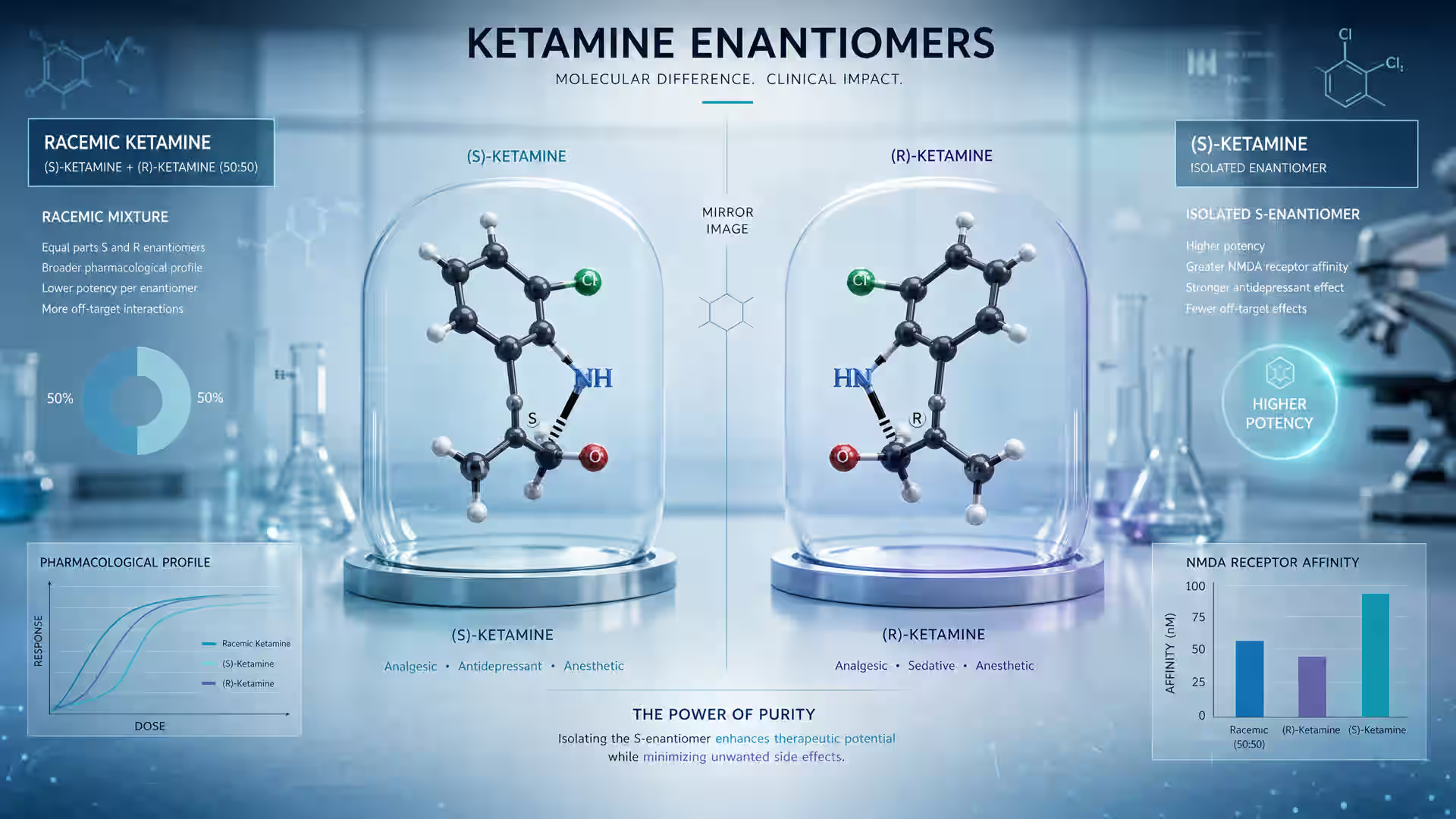
Standard commercial preparations of ketamine hydrochloride have historically been distributed as a racemic mixture. This means the solution contains an exact 50:50 ratio of its two constituent isomers: R-(-)-ketamine (Arketamine) and S-(+)-ketamine (Esketamine). The symbols (-) and (+) denote the direction in which each specific molecule rotates polarized light, a core physical characteristic used in analytical chemistry to verify structural composition and purity layers.
When an individual receives a racemic formulation, their metabolic pathways process both molecules simultaneously. Although both enantiomers navigate the same systemic circulation, they exhibit markedly different pharmacokinetic tracks, clearance rates, and receptor binding behaviors. For decades, the co-administration of these mirror-image molecules was standard practice because isolating individual enantiomers on an industrial scale required complex, high-cost chemical synthesis and purification infrastructure. Today, specialized analytical testing ensures that these precise ratios remain stable, predictable, and free from external manufacturing contaminants.
The S-(+)-Enantiomer: Enhanced Potency and NMDA Affinity
The right-handed isomer, S-(+)-ketamine, represents a significant shift toward targeted molecular medicine. Research confirms that the therapeutic effects of the compound are primarily mediated through its action as a non-competitive antagonist at the N-methyl-D-aspartate (NMDA) receptor, an ionotropic glutamate receptor deeply involved in synaptic plasticity, pain transmission lines, and memory formation.
When evaluated in isolated laboratory environments, the S-(+)-enantiomer demonstrates an NMDA receptor binding affinity that is approximately four times greater than that of the isolated R-(-) enantiomer. Consequently, when compared directly to the traditional 50:50 blend, certified pharmacy grade ketamine hcl CAS 1867-66-9 in its pure S-enantiomer configuration exhibits roughly double the clinical potency of the racemic mix. This heightened affinity allows clinicians to achieve identical or superior anesthetic and analgesic thresholds using substantially lower volumetric doses. Lower dosing directly correlates with a reduced metabolic workload on the liver and kidneys, faster post-procedural clearance times, and a significant reduction in psychotomimetic side effects, such as intense emergence delirium or visual distortions.
Comparative Data: Pharmacokinetics and Receptor Bindings
To fully grasp the clinical divergence between these options, it is helpful to examine their precise operational metrics side by side. The table below outlines the core structural, binding, and metabolic differences between the standard racemic mixture and the isolated S-(+) enantiomer configuration.
| Pharmacological Parameter | Racemic Ketamine (1:1 Blend) | S-(+)-Ketamine Enantiomer (Esketamine) |
|---|---|---|
| Molecular Composition | 50% R-(-)-ketamine / 50% S-(+)-ketamine | 100% Pure S-(+)-enantiomer configuration |
| NMDA Receptor Affinity | Moderate (diluted by the presence of the R-isomer) | High (approximately 4x stronger than R-isomer) |
| Relative Clinical Potency | Baseline (1.0x) | Double Potency (2.0x baseline equivalent) |
| Primary Clearance Pathway | Hepatic N-demethylation to Norketamine variants | Rapid hepatic clearance to S-norketamine |
| Psychotomimetic Side Effects | Higher incidence of severe emergence reactions | Reduced intensity; cleaner post-anesthetic emergence |
| Common Clinical Presentation | Liquid injection vials and high-purity analytical powders | Intranasal delivery systems and premium IV lines |
Subanesthetic Applications and Neuroplasticity Pathways
While general high-dose anesthesia remains a vital asset in emergency trauma medicine and pediatric surgery, the past fifteen to twenty years have seen an explosion of interest in subanesthetic dosing frameworks. At fractions of the dose required to induce a complete dissociative state, both racemic and S-enantiomer variants trigger an alternative pharmacological cascade. Instead of shutting down consciousness, subanesthetic concentrations stimulate a transient surge in glutamate release, which in turn activates alpha-amino-3-hydroxy-5-methyl-4-isoxazolepropionic acid (AMPA) receptors.
This localized AMPA activation upregulates the synthesis and release of Brain-Derived Neurotrophic Factor (BDNF), a vital growth factor that acts as fertilizer for brain cells. This process stimulates rapid synaptogenesis—the physical rebuilding and repair of damaged dendritic spines and neural pathways in regions of the brain like the prefrontal cortex. This neuroplastic healing mechanism explains why researchers utilize these compounds to study rapid reversals of treatment-resistant mood conditions and neurological pain pathways that fail to respond to traditional, slow-acting oral options. For professionals seeking to maintain steady clinical trial parameters, sourcing bulk ketamine vials for clinical veterinary research or validated human therapeutic lines requires absolute clarity regarding which molecular profile is being deployed.
Bioavailability Profiles Across Administration Routes
The ultimate efficacy of any chiral compound depends heavily on its route of administration and corresponding bioavailability profile—the exact percentage of the active compound that enters systemic circulation unchanged. When evaluating ketamine liquid vs powder bioavailability ratios, clinicians must account for distinct physical transitions.
Intravenous injection provides an absolute baseline of 100% bioavailability for both racemic and S-enantiomer solutions, as it bypasses all physiological absorption barriers. Intramuscular injection follows closely, offering a reliable absorption rate of approximately 93%. However, alternative off-label non-invasive administration routes introduce significant metabolic variables. Intranasal delivery typically yields roughly 45% to 50% bioavailability, making it an efficient choice for targeted, non-needle delivery of the potent S-enantiomer. Oral administration, by contrast, drops significantly to between 17% and 20% due to the harsh environment of the gastrointestinal tract and the robust first-pass metabolism of the liver, which rapidly converts the active compound into its downstream metabolite, norketamine.
Logistical Standards for Cold-Chain and Vacuum Preservation
Maintaining the delicate chemical stability and structural purity of these formulations requires rigid adherence to international material handling protocols. Because these substances are sensitive to extreme thermal fluctuations, high-humidity exposure, and atmospheric cross-contamination, specialized logistics providers utilize defensive multi-layered packaging solutions.
Liquid vials and high-purity crystalline powders must be held within strict temperature parameters—ideally between 15°C and 30°C for standard room-temperature configurations, or tightly controlled cold-chain environments if formulated alongside specific preservative-free saline carriers. To eliminate the risk of ambient moisture degrading the crystal lattice structure or inducing premature hydrolytic breakdown, advanced containment facilities mandate industrial-grade vacuum sealing combined with opaque, light-blocking outer barriers. These specialized protocols guarantee that when a compound arrives at a certified laboratory facility, its enantiomeric purity and analytical integrity remain perfectly intact from the point of manufacture to final scientific application.
Verified Institutional Sourcing Frameworks
For modern research facilities, independent laboratories, and therapeutic practitioners, procuring validated chemical compounds requires a logistics partner that understands the high stakes of molecular purity. At LyfeUnit, we eliminate sourcing ambiguity by subjecting every batch to rigorous independent analytical testing, guaranteeing precise enantiomeric ratios, zero contaminant overhead, and complete batch transparency.
Our global transport architecture utilizes multi-layered containment, automated vacuum sealing, and discrete, end-to-end tracked logistics options to ensure your materials arrive with their molecular stability fully preserved. Discover our institutional product catalog and secure your supply line today using our encrypted checkout network.
Frequently Asked Questions Regarding Enantiomeric Purity
What is the difference between racemic ketamine and S-enantiomer (Esketamine)?
The primary difference lies in their spatial molecular arrangement. Racemic ketamine is an equal 1:1 mixture of both the left-handed (R) and right-handed (S) enantiomers. S-enantiomer formulations isolate only the right-handed molecule, resulting in a compound that exhibits a four-fold higher affinity for the NMDA receptor and double the clinical potency of the mixed racemic solution.
Why is the CAS registry number 1867-66-9 significant for verification?
The CAS registry number 1867-66-9 is the unique global identifier assigned by the Chemical Abstracts Service specifically for Ketamine Hydrochloride. Utilizing this exact numerical tag during laboratory procurement and independent mass-spectrometry validation ensures that the compound matches official international pharmaceutical standards and is completely free from illicit analogs or structural variants.
How do the side effect profiles differ between the two formulations?
Because pure S-enantiomer formulations achieve identical therapeutic and analgesic thresholds at half the physical dose of a racemic mixture, patients experience significantly lower metabolic strain. This dose reduction results in a cleaner, more stable emergence profile, with a lower incidence of severe psychological side effects, cognitive dissociation, and emergence delirium.
Can liquid formulations be converted directly into analytical powders without losing purity?
Evaporative or thermal reduction methods can transition liquid solutions into crystalline powder forms for specific laboratory use. However, if the process is subjected to unmonitored or excessive heat thresholds, the chemical structure can experience partial degradation. To protect the integrity of the compound, researchers must prioritize pre-formulated, analytical-grade powders that have been prepared under strict, temperature-controlled laboratory conditions.
Does LyfeUnit offer fully insured tracking on international shipments?
Yes. All laboratory allocations managed through our distribution hubs are encased in defensive, vacuum-sealed packaging and dispatched using secure, end-to-end delivery networks. Every shipment includes encrypted tracking details, providing absolute transit visibility while fully protecting customer privacy through our specialized decentralized checkout interface.
When evaluated in isolated laboratory environments, the S-(+)-enantiomer demonstrates an NMDA receptor binding affinity that is approximately four times greater than that of the isolated R-(-) enantiomer. Consequently, when compared directly to the traditional 50:50 blend, certified pharmacy grade ketamine hcl CAS 1867-66-9 in its pure S-enantiomer configuration exhibits roughly double the clinical potency of the racemic mix. This heightened affinity allows clinicians to achieve identical or superior anesthetic and analgesic thresholds using substantially lower volumetric doses.
Liquid vials and high-purity crystalline powders must be held within strict temperature parameters—ideally between 15°C and 30°C for standard room-temperature configurations. To protect structural integrity during international transit, advanced containment hubs align operations with the WHO Good Distribution Practices (GDP) for Pharmaceutical Products. These specialized safety frameworks guarantee that when a compound arrives at a certified laboratory facility, its enantiomeric purity and analytical integrity remain perfectly intact.
Medical Disclaimer & Safety Information
Important Notice: The information provided by Lyfeunit on this website, including text, graphics, and product descriptions, is for general informational and educational purposes only. It is not intended as a substitute for professional medical advice, diagnosis, or treatment.